Financial markets often exhibit periods of sustained directional movement. These phases are commonly referred to as trends and are observed across asset classes, timeframes, and market environments. Trend following, as a concept, describes the observation of these directional phases within price structure rather than an attempt to anticipate turning points or reversals.
In market analysis, trends are discussed as expressions of collective behavior over time. When directional movement persists, it reflects ongoing alignment among market participants, influenced by factors such as macroeconomic conditions, sentiment, and capital allocation. This article examines how trends are defined, how they are observed in historical price data, and the limitations of trend-based interpretation.
Risk Warning: CFDs are complex instruments and come with a high risk of losing all your invested capital. This content is provided as a general marketing communication for informational purposes only and does not constitute investment advice, trading guidance, or a recommendation.
What Is a Market Trend
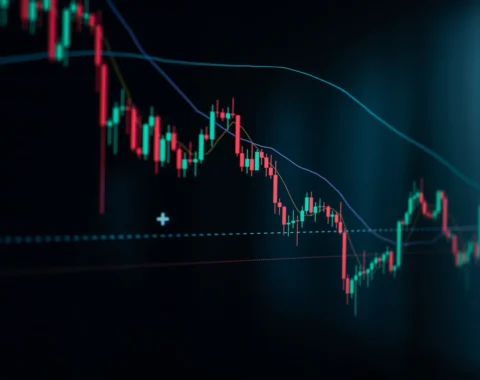
A market trend represents sustained directional price movement over a given period. Trends are identified through the sequence of price swings rather than individual price changes. An upward trend is commonly described as a series of progressively higher swing highs and higher swing lows, while a downward trend is described by lower highs and lower lows. Periods without clear directional progression are often described as range-bound or sideways.
Trends are not static and do not exist in isolation. They emerge, evolve, and eventually dissipate as market conditions change. Their duration and clarity vary depending on factors such as timeframe, liquidity, and volatility.
Timeframes and Trend Observation
Trends can be observed across multiple timeframes, from very short-term price movement to long-term market cycles. A trend visible on a higher timeframe may coexist with counter-movement on a lower timeframe, highlighting the layered nature of market structure.
Multi-Timeframe Structure
Market analysis often references the interaction between timeframes to explain why price behavior may appear inconsistent when viewed narrowly. Higher timeframe structure tends to reflect broader participation and longer-term capital flows, while lower timeframe movement may reflect short-term adjustments or noise.
Understanding this hierarchy helps explain why trends are discussed as contextual features rather than fixed conditions.
Price Structure and Directional Behavior
Trend discussion centers on price structure rather than prediction. Structure refers to how price organizes itself over time through sequences of expansion, contraction, and continuation. Directional behavior becomes apparent when these sequences align consistently in one direction.
Structural Characteristics Commonly Observed
Analytical commentary often highlights recurring characteristics associated with trending behavior:
- Repeated directional price expansion
- Shallow counter-movement relative to the dominant direction
- Gradual progression of swing points
- Sustained movement over extended periods
These characteristics describe how trends appear in historical data, not how they should be acted upon. After identifying these features, analysts typically compare current price behavior to past periods to assess similarity, without assuming repetition.
Trend Interpretation in Market Context
Trends are not interpreted independently of their environment. Broader market context influences how directional movement is perceived and discussed. Volatility, liquidity conditions, and external events all affect how trends develop and persist.
Environmental Factors Affecting Trends
Trend behavior is often discussed alongside contextual elements such as:
- Changes in volatility regimes
- Shifts in liquidity availability
- Macroeconomic developments
- Cross-market relationships and correlations
These factors help explain why trends may accelerate, stall, or reverse without warning. By incorporating context, analysts avoid treating trends as linear or guaranteed phenomena.
Common Descriptive Tools in Trend Analysis
Market literature frequently references certain analytical tools to describe trends visually. These tools are discussed as descriptive aids rather than predictive mechanisms.
Tools Used for Structural Description
Commonly referenced tools include:
- Moving averages, used to smooth price data and illustrate direction
- Trendlines, used to visualize swing progression
- Price channels, used to frame directional movement within boundaries
These tools do not create trends. They provide visual representations that help describe existing price behavior. Their interpretation remains subjective and dependent on the broader context.
Limitations of Trend-Based Interpretation
While trends are a prominent feature of market structure, they have clear limitations. Not all markets trend, and trending phases can end abruptly. Periods of consolidation or rapid reversal can disrupt previously sustained directional movement.
Commonly Acknowledged Constraints
Analytical sources often highlight limitations such as:
- Trends may appear clear in hindsight, but less so in real time
- Directional movement can change due to external events
- Volatility expansion can distort structural clarity
- Extended non-trending phases reduce directional relevance
These constraints reinforce why trend observation is treated as a descriptive framework rather than a decision-making model.
Trends Within Broader Market Behavior
Trend following concepts persist in market discussion because they offer a way to describe how price behavior organizes itself over time. They provide language for explaining prolonged directional movement without requiring assumptions about duration or outcome.
Trends are one component of market structure among many. Their interpretation depends on the timeframe, environment, and historical comparison rather than certainty.
Conclusion
Trend following, when discussed as a conceptual framework, refers to the observation of sustained directional behavior within market structure. Trends reflect periods of collective alignment among market participants and are visible through recurring price patterns across timeframes.
Understanding trends as descriptive features rather than actionable signals supports a more balanced view of market behavior. Their value lies in contextual interpretation and structural awareness, not in prediction or execution.
Frequently Asked Questions
1. What is trend following in trading?
Trend following is a strategy that focuses on identifying and trading in the direction of a prevailing market trend rather than predicting reversals.
2. How can traders identify a strong trend?
Traders often analyze higher highs and higher lows, moving averages, and momentum indicators to confirm directional bias.
3. Can trend strategies be used on multiple markets?
Yes. Trend-following approaches can be applied to forex, indices, commodities, and other liquid markets available on platforms like SIFX.
4. What tools help with trend analysis?
Charting tools, time-frame analysis, and market structure observation are commonly used to support trend-based decision-making.