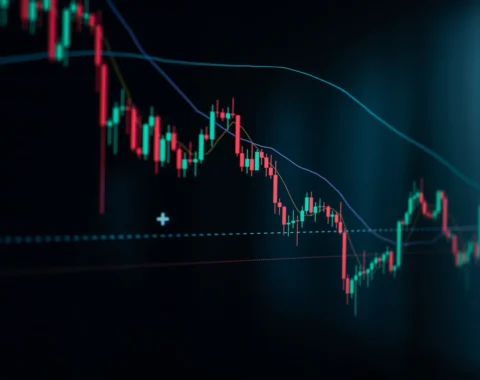
Price charts provide a visual record of how buyers and sellers have interacted over time. Candlestick patterns are commonly referenced in market analysis as a way to describe recurring formations that emerge from this interaction. These formations summarize price behavior within defined time periods and reflect how market pressure, balance, or rejection has manifested historically.
Candlestick patterns are discussed across asset classes because they rely solely on price data rather than external indicators. Their relevance comes from their ability to visually represent market interaction in a consistent format, allowing analysts to compare historical behavior across different instruments and environments without assuming predictability or outcome.
Risk Warning: CFDs are complex instruments and come with a high risk of losing all your invested capital. This content is provided as a general marketing communication for informational purposes only and does not constitute investment advice, trading guidance, or a recommendation.
What Candlestick Patterns Represent
Each candlestick summarizes price activity during a specific time interval by displaying the open, high, low, and close. The relationship between these elements reflects how the price moved within that period and whether buying or selling pressure was more prominent.
Candlestick patterns form when similar price relationships repeat over time. These repetitions are observed rather than engineered and are often discussed as reflections of market behavior rather than signals of future movement.
Components of a Candlestick
A candlestick consists of several visual elements:
- The body, representing the range between open and closed
- The upper shadow, showing the highest traded price
- The lower shadow, showing the lowest traded price
- Color or fill, indicating directional movement within the period
These components together describe how price evolved during the selected timeframe. By examining these components, analysts gain insight into whether price movement was decisive, contested, or balanced during that interval. This interpretation remains descriptive and does not imply continuation or reversal.
Behavioral Interpretation of Candlestick Formations
Candlestick patterns are often discussed in behavioral terms because they visually express how market participants responded to price movement. Long shadows may reflect rejection, small bodies may reflect balance, and extended bodies may reflect directional pressure.
Repetition and Market Observation
Patterns gain analytical relevance when similar formations appear under comparable conditions. This repetition allows analysts to compare current price behavior with historical interaction, providing context rather than instruction.
Common behavioral characteristics observed include:
- Rejection of higher or lower prices
- Temporary balance between buying and selling pressure
- Strong directional movement within a single period
- Gradual loss of momentum following extended movement
These characteristics are descriptive markers used to explain how price behaved, not to define what should happen next. After identifying these behavioral features, analysts typically examine broader market structure to determine whether the pattern aligns with historical behavior observed in similar contexts.
Structural Categories of Candlestick Patterns
Candlestick formations are often grouped into broad structural categories to organize observation. These categories are analytical constructs used to describe behavior rather than rigid classifications.
General Pattern Groupings
Common structural groupings include:
- Single-candle formations, reflecting concentrated activity within one period
- Multi-candle formations, showing behavior developing over multiple intervals
- Consolidation formations, reflecting balance or compression
- Expansion formations, reflecting increased directional pressure
These groupings help describe how price behavior unfolds across time rather than focusing on individual candles in isolation. Once grouped, patterns are interpreted alongside surrounding price behavior, volatility, and historical context to assess whether the observed structure resembles prior market interaction.
Candlestick Patterns and Market Context
Context plays a central role in how candlestick patterns are discussed. The same formation may appear under different conditions, producing different interpretations depending on the surrounding structure.
Importance of Location and Environment
Candlestick formations are often evaluated relative to:
- Broader directional movement
- Proximity to historically significant price areas
- Volatility conditions at the time of formation
- Timeframe alignment with larger structural trends
These contextual factors influence how patterns are interpreted as reflections of market behavior rather than isolated occurrences. By examining patterns within their environment, analysts avoid treating them as standalone explanations and instead view them as part of a broader structural narrative.
Commonly Observed Candlestick Formations
Certain candlestick formations are frequently discussed in market literature due to their recurring appearance and clear visual structure. These formations have been documented across different markets and timeframes.
The table below provides a descriptive overview of commonly referenced candlestick formations and the type of price behavior they are typically associated with. This information is explanatory only.
| Pattern Name | Observed Price Behavior | Typical Market Context |
| Pin Bar | Strong rejection within a single period | Near historically reactive zones |
| Engulfing Formation | Shift in short-term pressure | Following directional movement |
| Inside Bar | Temporary compression | Periods of reduced volatility |
| Doji | Balance or indecision | Transitional or extended moves |
| Marubozu | Strong directional dominance | Momentum-driven environments |
This table serves as a classification reference rather than a decision framework. It summarizes how these formations are commonly described in analytical commentary. Following identification, analysts usually compare current examples to historical occurrences to evaluate similarity, without assuming repetition or outcome.
Limitations of Candlestick Pattern Analysis
Candlestick patterns do not provide certainty or predictive accuracy. Markets can change behavior quickly, and formations may appear without leading to consistent outcomes.
Several limitations are commonly acknowledged:
- Patterns can occur frequently without follow-through
- Volatility changes can alter interpretation
- Liquidity conditions may distort price representation
- Historical repetition does not ensure future similarity
These limitations highlight why candlestick patterns are treated as descriptive tools rather than deterministic models. Understanding these constraints helps maintain realistic expectations and reinforces the importance of broader market awareness.
Candlestick Patterns in Analytical Practice
Within market analysis, candlestick patterns are used to describe how the price has behaved rather than to define what actions should be taken. Their value lies in visualization and comparison, not instruction.
Repeated observation across different environments supports familiarity with how price behavior can vary under similar structural conditions. This observational process contributes to analytical understanding rather than operational decision-making.
Conclusion
Candlestick patterns represent a visual method for describing price behavior and historical interaction between buyers and sellers. They summarize how prices moved within defined periods and highlight recurring behavioral characteristics observed across markets.
When approached as analytical descriptors rather than execution tools, candlestick patterns contribute to a broader understanding of market structure and behavior. Their relevance lies in interpretation and context, not prediction or instruction.
Frequently Asked Questions
1. What are candlestick patterns?
Candlestick patterns are visual formations on price charts that help traders interpret market sentiment and potential shifts in direction.
2. Are candlestick patterns reliable on their own?
They are often more effective when combined with support/resistance levels, trend analysis, and broader market context.
3. Which patterns are most commonly used?
Engulfing candles, pin bars, and doji formations are widely observed for potential momentum or reversal signals.
4. Can beginners learn candlestick analysis easily?
Yes. Many platforms provide charting tools and educational resources that help traders learn how to interpret candlestick behavior over time.