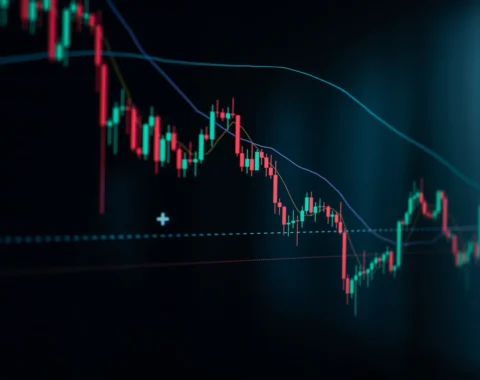
Modern electronic markets do not always move smoothly. At times, price accelerates so quickly that it leaves gaps in traded activity. These gaps are known as liquidity voids — areas on the chart where little to no transaction volume occurred. Liquidity voids form when the market moves through price levels faster than liquidity providers can supply or replenish orders. Understanding these voids helps analysts interpret why markets revisit certain areas, how volatility behaves, and why rebalancing occurs even without news or sentiment shifts.
Risk Warning: Liquidity void analysis explains structural behavior but does not predict future outcomes. Voids may or may not fill depending on liquidity, volatility, and market conditions.
Liquidity voids are neither positive nor negative. They simply represent imbalance — an area where price moved rapidly because supply and demand were not aligned. Over time, markets often return to these zones to rebuild traded volume and restore structural balance.
What Creates a Liquidity Void
Liquidity voids appear when aggressive order flow overwhelms available depth. If a large wave of buy or sell orders consumes multiple price levels in seconds, the market may skip intermediate liquidity entirely. This creates a visible gap where little data exists.
These voids often occur during:
- Major economic announcements
- Rapid sentiment shifts
- Low-liquidity periods, such as overnight sessions
- Algorithmic bursts of activity
Once formed, they mark an area of structural inefficiency that price may revisit under normal conditions.
The Nature of Structural Inefficiency
Markets function efficiently when each price level contains sufficient activity. When a void forms, the structure becomes uneven. Analysts consider these areas incomplete because they reflect movement that lacked normal participation.
Over time, markets often migrate back into inefficient zones to generate missing traded volume. This process is known as price rebalancing, and it restores structural integrity to the chart.
Why Price Rebalances
The concept of rebalancing comes from order flow dynamics. When price moves too quickly through an area, resting orders are left behind. Later, when conditions stabilize, the market often retests these zones so participants can re-enter or exit at levels that were skipped.
Here’s what rebalancing essentially leads to:
- Redistribute liquidity
- Absorb previously missing order flow
- Smooth out volatility
- Restore normal price progression
This is a function of market structure, not predictive expectation.
Identifying Liquidity Voids on the Chart
Liquidity voids show up visually as areas where candles move with unusually large bodies and minimal overlap. The chart displays:
- Long directional bars
- Reduced wick activity
- Minimal inside-candle trading
- Strong displacement from one area to another
These characteristics highlight a region where liquidity was insufficient to provide resistance or support.
Example Scenario
Consider a futures market experiencing a surprise policy announcement. A surge of sell orders pushes the price rapidly downward. Within seconds, several price levels are consumed without meaningful trading. A clear void forms.
Hours later, as trading normalizes, the price gradually rises to retest the zone. This upward movement is not necessarily a reversal. It is the market filling an area where structural activity was missing.
This example shows how voids guide later movement without implying direction.
Void Depth and Market Behavior
Not all voids behave equally. Some are shallow, created by moderate bursts of activity. Others span wide ranges during extreme volatility. Deeper voids often take longer to rebalance because more missing volume must be absorbed.
Key considerations include:
- Size of displacement
- Volume on entry and exit
- Speed of formation
- Context within the broader trend
Large voids within strong trends may rebalance slowly, while voids created by temporary shocks may fill quickly.
How Rebalancing Occurs
Rebalancing can happen in several ways.
- Gradual drift into the void through normal trading
- Sharp retracement that quickly refills the area
- An extended consolidation that spans the void region
- Multiple partial passes before full volume develops
What matters is not the method but the reason — restoring liquidity to a structurally thin region.
Relationship Between Voids and Volatility
Voids often act as magnets during stable periods because they offer low resistance to price movement. As price enters a void, volatility can increase due to the lack of historical transaction density.
Conversely, once a void is filled, volatility often stabilizes as the market rebuilds depth and balance. This interplay explains why some moves accelerate inside voids and slow immediately upon exiting them.
Liquidity Voids Across Timeframes
Voids appear on all timeframes, from seconds to days.
- On lower timeframes, they represent microstructural gaps caused by fast execution.
- On higher timeframes, they reflect broader market dislocations during major events.
Larger timeframe voids hold structural significance longer because they represent a more substantial imbalance.
Limitations of Void Interpretation
Liquidity voids offer insight into where the market may seek balance, but they do not guarantee return or provide directional signals. A strong trend may bypass a void indefinitely. In rare cases, voids remain unfilled for extended periods due to persistent imbalance or structural shifts.
Analysts must treat voids as contextual features rather than predictive tools.
Final Thoughts
Liquidity voids reveal the market’s structural weaknesses, showing where price lacked participation during rapid movement. Over time, markets often revisit these imbalanced areas to rebuild volume and restore stability. Understanding how voids form, how they influence volatility, and how rebalancing unfolds provides deeper insight into the mechanics of price behavior.
Risk Warning: Liquidity voids reflect incomplete traded areas and do not imply future price direction. Market conditions, volatility, and sentiment can prevent or delay rebalancing.
Frequently Asked Questions
1. What is a liquidity void?
A liquidity void occurs when the price moves quickly through an area with little trading activity, often leaving a gap in transactions.
2. Why does price return to these areas?
Markets sometimes revisit low-liquidity zones to rebalance supply and demand and fill untraded price levels.
3. How do traders identify these zones?
They are often spotted through sharp price movements on charts where limited consolidation occurred.
4. Can liquidity analysis improve trade timing?
Some traders use liquidity zones alongside technical analysis to better understand potential areas of reaction or consolidation.